
How to Pay Off Credit Card Debt: A Practical Step-by-Step Guide
Credit card debt can start quietly. One unexpected bill, a few online purchases, or a month when your income falls short may not seem like a serious problem. But when balances continue from one billing cycle to the next, interest can make the debt increasingly difficult to manage.
The good news is that credit card debt does not have to control your finances forever. With a realistic repayment plan, careful spending, and consistent payments, you can gradually reduce what you owe and create more room in your monthly budget.

This guide explains how to pay off credit card debt step by step, including how to organize your balances, choose a repayment strategy, reduce interest costs, and avoid falling back into the same cycle.
Table of Contents
- Understand How Much Credit Card Debt You Have
- Stop Adding New Debt
- Create a Debt Repayment Budget
- Choose a Debt-Payoff Strategy
- Always Pay at Least the Minimum
- Put Extra Money Toward Your Debt
- Look for Ways to Reduce Interest
- Consider Balance Transfers Carefully
- Contact Your Credit Card Company
- Avoid Debt-Relief Scams
- Build an Emergency Fund
- Stay Out of Credit Card Debt
- Frequently Asked Questions
- Final Thoughts
1. Understand How Much Credit Card Debt You Have
Before trying to eliminate your credit card debt, you need a clear picture of what you owe.
If you have several cards, write down the balance, APR, minimum payment, and payment due date for each account.
For example:
| Credit Card | Balance | APR | Minimum Payment |
|---|---|---|---|
| Card A | $2,400 | 24% | $75 |
| Card B | $1,200 | 19% | $40 |
| Card C | $800 | 29% | $30 |
In this example, the total debt is $4,400.
Seeing the complete number may feel uncomfortable, but avoiding it does not make the debt disappear. Knowing your starting point allows you to create a realistic plan.
Also check your statements for different APRs, fees, promotional rates, and repayment information. Credit card interest is often calculated daily, so carrying a balance can increase the cost of borrowing over time.

2. Stop Adding New Debt
Paying off a credit card while continuing to make large purchases on the same card can feel like trying to empty a bucket while water is still running into it.
If possible, stop using your credit cards for unnecessary purchases while you work on repayment.
This does not necessarily mean you must immediately close every account. Closing cards can have consequences depending on your situation. Instead, focus on changing the spending behavior that caused the balance to grow.
Before using a credit card, ask yourself:
- Is this purchase necessary?
- Can I pay for it from my current income?
- Will buying it increase my debt?
- Could I wait until I have the cash available?
Small decisions can make a significant difference over several months.
3. Create a Debt Repayment Budget
Your debt-payoff plan needs to fit your actual income.
Start by listing your monthly income and essential expenses, including:
- Housing
- Food
- Utilities
- Transportation
- Insurance
- Minimum debt payments
- Medical expenses
- Other necessary bills
Then look at your remaining money.
Suppose you have $500 left after essential expenses and minimum debt payments. You might decide to direct $350 toward additional credit card payments while keeping $150 available for irregular expenses.
The exact amount will depend on your circumstances. A plan that you can maintain every month is generally more useful than an aggressive plan that forces you to rely on credit again.

4. Choose a Debt-Payoff Strategy
Two common approaches are the debt avalanche and the debt snowball.
Debt Avalanche
With the avalanche approach, you make at least the required payment on every debt and direct additional money toward the balance with the highest interest rate.
Once that debt is paid off, you move the extra payment to the next highest-rate balance.
The goal is to attack the debt that is costing you the most in interest.
Debt Snowball
The snowball method focuses on the smallest balance first.
You continue making the required payments on your other accounts while putting extra money toward the smallest debt. After that balance disappears, you move the payment to the next-smallest debt.
The CFPB identifies both the highest-interest-rate method and the snowball method as common debt-reduction strategies.
Neither method changes the amount you owe overnight. The important part is choosing an approach you understand and can consistently follow.
5. Always Pay at Least the Minimum
If you cannot pay your entire credit card balance, make at least the required minimum payment by the due date.
Missing payments can result in fees and other consequences, and late payments can affect your credit history.
However, the minimum payment should generally be viewed as the amount needed to keep the account current—not necessarily as your complete debt strategy.
Paying only the minimum can stretch repayment over a long period and increase the total interest you pay. Credit card statements can also provide information about how long repayment could take under minimum-payment assumptions.
Whenever your budget allows, pay more than the minimum.
6. Put Extra Money Toward Your Debt
Extra payments do not have to come from your regular paycheck alone.
You might temporarily redirect money from:
- Restaurant spending
- Unused subscriptions
- Entertainment
- Impulse purchases
- Online shopping
- Unplanned upgrades
You can also consider putting occasional extra income toward your debt, such as a bonus, freelance earnings, or money from selling items you no longer need.
Imagine you normally pay $100 toward a credit card but find an additional $50 in your monthly budget. That extra $50 can be added to your planned payment.
The goal is not necessarily to make your lifestyle miserable. The goal is to create a temporary gap between what you earn and what you spend and use part of that gap to eliminate expensive debt.
7. Look for Ways to Reduce Interest
Interest is one of the biggest obstacles when paying down revolving credit card balances.
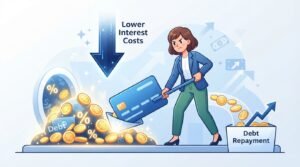
The lower your interest cost, the more of your payment can go toward reducing the underlying balance.
Review the APR on each card and understand which balance is costing you the most. In general, paying down higher-interest debt can reduce the amount of interest accumulating over time.
If you have several balances, this is one reason the debt-avalanche strategy can be useful.
Also avoid assuming that a lower monthly payment automatically means a cheaper option. A longer repayment period can reduce the monthly amount while increasing the total amount paid.
8. Consider Balance Transfers Carefully
A balance transfer can sometimes move existing credit card debt to another card with a promotional interest rate.
However, this option requires careful planning.
Balance transfers may involve fees, and promotional rates generally last only for a limited period. After the promotional period ends, the regular APR may apply.
Before transferring a balance, check:
- The balance-transfer fee
- Promotional APR
- Length of the promotional period
- Regular APR after the promotion
- Required minimum payments
- Whether new purchases receive a grace period
- Whether you can realistically repay the balance before the promotional rate ends
A balance transfer can change the cost structure of your debt, but it does not eliminate the debt itself.

9. Contact Your Credit Card Company
If you are struggling to make your payments, do not automatically wait until the situation becomes worse.
Contact the credit card company and explain your circumstances.
Depending on the issuer and your situation, you may be offered options such as a modified payment arrangement, reduced payment, lower interest rate, or hardship program. The CFPB recommends contacting your card company as soon as you realize you may have trouble making payments.
When speaking with the company, be prepared to explain:
- Why you are struggling
- How much you can afford to pay
- Your current income
- When you expect your situation to improve
- What type of payment arrangement you are requesting
If you agree to a special arrangement, carefully review the terms and keep documentation of the agreement.
https://hamzaft.com/create-a-monthly-budget-that-actually-works/
10. Avoid Debt-Relief Scams
When people are overwhelmed by debt, they can become easy targets for companies promising instant solutions.
Be cautious about anyone who:
- Guarantees that your debt will disappear
- Demands large upfront fees
- Tells you to stop communicating with your creditors
- Tells you to stop making payments without clearly explaining the consequences
- Promises a specific debt reduction without reviewing your financial situation
The CFPB specifically warns consumers to be careful with debt-settlement companies that make unrealistic promises or encourage people to stop communicating with creditors or making payments.
If you need professional assistance, research the organization carefully and understand its fees and services before signing an agreement.
11. Build an Emergency Fund
Paying off debt is important, but having no emergency savings can make the process harder.
Consider building a small emergency fund while you repay your credit cards.
Why?
Because unexpected expenses happen.
A car repair, medical bill, temporary income interruption, or urgent household expense could otherwise force you to use your credit card again.
You do not necessarily need a huge emergency fund immediately. Even a modest cash reserve can provide some protection against unexpected expenses.
Once your credit card debt is under control, you can gradually increase your emergency savings.
12. Stay Out of Credit Card Debt
Paying off your balance is a major step, but keeping it under control is the long-term goal.
After becoming debt-free, consider using a simple system:
Income → Essential expenses → Savings → Planned spending
If you use a credit card for convenience or rewards, try to treat it like a payment method rather than extra income.
For example, if you spend $100 on groceries using a credit card, make sure that $100 is already accounted for in your budget.
That mindset can help prevent the balance from growing again.
Frequently Asked Questions
How long does it take to pay off credit card debt?
There is no single answer. It depends on your balance, interest rate, minimum payment, and how much extra you pay each month.
Increasing your payment can significantly shorten the repayment period. The CFPB notes that making only minimum payments can take years in some circumstances.
Should I pay the smallest balance or the highest-interest card first?
You can use either the snowball or avalanche approach.
The snowball method targets the smallest balance, while the avalanche method targets the highest interest rate. Choose the approach that fits your financial situation and that you are most likely to follow consistently.
Should I stop using my credit cards while paying off debt?
If credit card spending is causing your balances to grow, temporarily stopping unnecessary card purchases can make repayment easier.
The important goal is to prevent new debt from undermining your repayment progress.
Is a balance transfer a good way to pay off credit card debt?
A balance transfer can potentially reduce interest costs during a promotional period, but fees, promotional expiration dates, and regular APRs must be considered carefully.
What if I cannot afford my minimum payment?
Contact your credit card company as soon as possible. Explain what you can afford and ask whether hardship or alternative payment options are available. The CFPB recommends acting quickly rather than ignoring the problem.
conclusion
Paying off credit card debt is less about finding one magical trick and more about creating a system that you can repeat every month.
Start by understanding exactly what you owe. Stop unnecessary new borrowing, build a realistic budget, choose a repayment method, and consistently direct extra money toward your balances.
If interest is making progress difficult, investigate legitimate options such as contacting your card issuer or carefully evaluating a balance transfer. If you cannot make your required payments, seek help early rather than waiting for the situation to become more serious.
Most importantly, remember that debt repayment is a process. A balance that took months or years to build may not disappear immediately. Consistent progress, even when it seems small, can move you toward a healthier financial position.
https://www.texasbaycu.org/articles/how-to-pay-off-credit-card-debt-in-10-steps
1 thought on “How to Pay Off Credit Card Debt”