
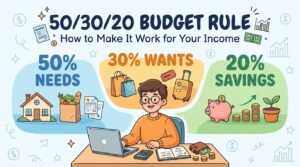
50/30/20 Budget Rule: How to Make It Work for Your Income
Managing money can feel difficult when rent, groceries, bills, transportation, and other expenses compete for the same paycheck. Even if you earn a reasonable income, you may wonder where your money goes each month. Without a clear plan, saving for the future can become an afterthought.
The 50/30/20 budget rule offers a straightforward way to organize your finances. Instead of tracking every dollar in complicated spreadsheets, you divide your after-tax income into three main categories: needs, wants, and savings or debt repayment.
The best part is that you can adjust this method to fit your income, living expenses, and financial goals. You do not need a high salary to start budgeting. You need a realistic understanding of what you earn, what you spend, and what you want your money to accomplish.
In this guide, you will learn how the 50/30/20 budget rule works, how to calculate your personal budget, and how to adapt it when your income does not fit the traditional percentages.
Table of Contents
- What Is the 50/30/20 Budget Rule?
- Understanding the Three Budget Categories
- How to Calculate Your 50/30/20 Budget
- A Practical Monthly Budget Example
- How to Make the Rule Work on a Low Income
- What to Do When Your Needs Exceed 50%
- Common Budgeting Mistakes to Avoid
- Tips for Following the Rule Every Month
- Is the 50/30/20 Budget Rule Right for You?
- Frequently Asked Questions
- Final Thoughts
1. What Is the 50/30/20 Budget Rule?
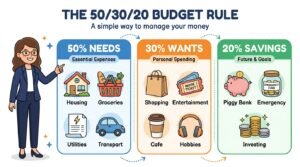
The 50/30/20 budget rule is a money-management method that divides your monthly take-home income into three spending categories.
- 50% for needs: Essential expenses you must cover.
- 30% for wants: Optional purchases and lifestyle choices.
- 20% for savings and debt repayment: Money reserved for future goals and financial obligations beyond your regular bills.
The purpose of this method is to create balance. You can pay your essential bills, enjoy some of your income today, and still make progress toward financial security.
For example, if your monthly take-home income is $3,000, the traditional rule suggests allocating $1,500 to needs, $900 to wants, and $600 to savings and additional debt repayment.
These percentages are guidelines rather than strict requirements. Someone living in an expensive city may need more than half of their income for housing and utilities. Another person with low living costs may be able to save more than 20%.
The goal is not to follow the percentages perfectly. It is to build a spending plan that reflects your circumstances and helps you use money intentionally.
2. Understanding the Three Budget Categories
Before calculating your budget, it is important to understand which expenses belong in each category. Some purchases may appear essential at first but actually represent optional choices.
50% for Needs
Needs are expenses you must pay to maintain a reasonable standard of living. They generally include necessities related to housing, food, transportation, utilities, and essential financial obligations.
Common examples include:
- Rent or a basic mortgage payment
- Electricity, water, heating, and essential internet access
- Groceries and basic household supplies
- Transportation needed to get to work or school
- Health insurance and necessary medical expenses
- Essential phone service
- Minimum required payments on credit cards, personal loans, or other debts
- Childcare required for work
The key question is whether you could reasonably eliminate the expense without affecting your basic needs or important responsibilities.
For example, buying groceries is a need, but ordering restaurant meals several times a week is usually a want. A basic phone plan may be necessary, while paying extra for a premium plan with features you rarely use may be optional.
If essential expenses consume more than 50% of your income, do not assume you have failed. Housing costs, family responsibilities, and income levels can make the traditional target difficult to achieve.
30% for Wants
Wants are purchases that improve your comfort, entertainment, convenience, or enjoyment but are not essential to meeting your basic needs.
Examples include:
- Restaurant meals and takeaway food
- Streaming subscriptions
- Movies, concerts, and other entertainment
- Nonessential clothing and accessories
- Vacations and leisure travel
- Gaming, hobbies, and recreational activities
- Upgrading electronics when your current devices still work
- Premium services and optional memberships
Wants are not automatically bad spending. A budget should allow room for enjoying your money instead of making every month feel restrictive.
The challenge is recognizing the difference between something you genuinely value and something you buy out of habit.
Suppose you spend $80 each month on subscriptions, but you regularly use only two of them. Canceling the unused services could free up money for savings without significantly affecting your lifestyle.
You can also choose which wants matter most. If spending time with friends is important to you, you might keep your social budget and reduce spending on impulse purchases instead.
20% for Savings and Debt Repayment
The final category focuses on improving your financial position and preparing for future expenses.
Depending on your situation, this portion can include:
- Building an emergency fund
- Saving for a home deposit
- Contributing to retirement accounts
- Investing for long-term goals
- Saving for education or professional training
- Making additional payments toward high-interest debt
- Setting aside money for predictable future expenses
You do not need to divide the 20% equally among every goal. Prioritize the needs that matter most right now.
For instance, someone without emergency savings may direct most of this category toward building a cash reserve. Someone with expensive credit card debt may prioritize paying it down while maintaining a modest emergency cushion.
Remember that minimum required debt payments generally belong in the needs category under this method. Additional payments toward debt can be included in the 20% category.
This distinction helps you understand how much money is going toward basic obligations and how much is actively improving your financial position.
3. How to Calculate Your 50/30/20 Budget
Creating a budget does not require complicated financial software. You can begin with a calculator, a notebook, a spreadsheet, or a budgeting application.
Follow these steps to create your own plan.
Step 1: Calculate Your Take-Home Income
Start with the money you actually receive after taxes and payroll deductions.
For employees, this usually means the amount deposited into your bank account after mandatory deductions. If you earn money through freelancing, contract work, or a small business, estimate your income after setting aside money for taxes and other necessary business costs.
If your monthly take-home income changes, calculate an average from several recent months. For greater safety, you can also build your essential budget around a conservative estimate of what you can reliably earn.
Step 2: Calculate 50% for Needs
Multiply your monthly take-home income by 0.50.
For example:
$3,000 × 0.50 = $1,500
This gives you a target of $1,500 for essential expenses. Add your housing, groceries, utilities, transportation, insurance, and minimum debt payments to see whether your current costs fit within this amount.
Step 3: Calculate 30% for Wants
Multiply your take-home income by 0.30.
$3,000 × 0.30 = $900
This is your suggested monthly allowance for nonessential spending. You can divide it among dining out, hobbies, entertainment, shopping, and other activities you enjoy.
Step 4: Calculate 20% for Savings and Debt Repayment
Multiply your take-home income by 0.20.
$3,000 × 0.20 = $600
Use this amount to work toward your financial goals. You might put some money into emergency savings, some toward additional credit card payments, and the remainder toward longer-term plans.
Step 5: Compare Your Targets With Actual Expenses
Your first calculation is only a starting point. Compare your suggested amounts with your real spending from the previous month.
If your essential expenses are $1,800 rather than $1,500, determine whether you can reduce some costs, increase your income, or temporarily adjust the percentages.
The point of a budget is to reflect reality and help you make better decisions, not to create numbers that look good on paper.

4. A Practical Monthly Budget Example

Imagine that an individual earns $4,000 per month after taxes. Here is one possible way to distribute that income according to the 50/30/20 rule.
| Category | Percentage | Monthly amount | Example expenses |
|---|---|---|---|
| Needs | 50% | $2,000 | Rent, groceries, utilities, transport, insurance |
| Wants | 30% | $1,200 | Dining out, entertainment, hobbies, shopping |
| Savings and extra debt repayment | 20% | $800 | Emergency fund, investments, extra debt payments |
| Total | 100% | $4,000 | Entire take-home income |
These amounts are illustrative targets, not recommended spending levels for every household.
Consider how the plan might work in practice.
The individual first covers essential bills, such as $1,200 for rent, $350 for groceries, $150 for utilities and phone service, and $300 for transportation and insurance. This leaves $2,000 in the needs category for other essential expenses or unexpected differences.
Next, the person sets a limit for optional spending. Instead of buying things whenever the opportunity arises, they plan how much to spend on meals out, entertainment, and hobbies.
Finally, $800 is assigned to financial goals. The individual might use $400 to build an emergency fund, $250 to make additional payments toward expensive debt, and $150 for long-term investing, depending on their circumstances.
This example shows how a budget can support current needs while leaving room for enjoyment and future security.
What If Your Income Is $2,000 or $5,000?
The same percentages can be applied to different income levels.
| Monthly take-home income | 50% Needs | 30% Wants | 20% Savings and debt |
|---|---|---|---|
| $2,000 | $1,000 | $600 | $400 |
| $2,500 | $1,250 | $750 | $500 |
| $3,000 | $1,500 | $900 | $600 |
| $4,000 | $2,000 | $1,200 | $800 |
| $5,000 | $2,500 | $1,500 | $1,000 |
The table illustrates the formula rather than a guarantee that each allocation will be realistic. If your essential expenses are higher than the suggested amount, adapt the percentages instead of ignoring necessary bills.
5. How to Make the Rule Work on a Low Income
Following a budget can be particularly challenging when most of your earnings already go toward basic living expenses. Rent, groceries, transportation, and utility bills can leave little room for savings.
If your income is limited, start by focusing on progress rather than perfect percentages.
Start With a Smaller Savings Amount
If saving 20% is currently unrealistic, begin with an amount you can maintain consistently.
For example, saving $20 or $50 each month is a useful starting habit if that money does not prevent you from paying essential bills. Increase the amount when your income improves or your expenses decrease.
The purpose is to establish a repeatable process rather than abandon saving because you cannot reach an ambitious target immediately.
Review Your Largest Expenses First
Small savings can help, but the largest expenses often have the greatest effect on a tight budget.
Review your housing, transportation, insurance, and recurring service costs. Consider whether a less expensive phone plan, a different commute, or a suitable housing arrangement could reduce your monthly obligations.
Do not make a change solely because it looks cheaper. Account for safety, time, reliability, and any additional costs before deciding.
Plan Purchases Before You Spend
Impulse purchases can consume money that is needed for food, transportation, or bills. Before shopping, make a list and establish a spending limit.
For nonessential purchases, consider waiting a day or two before buying. This gives you time to decide whether the item is worth its cost.
Look for Realistic Ways to Increase Income
Reducing expenses has limits. If your essential costs already consume nearly all your income, consider whether additional earnings are possible.
Depending on your circumstances, options might include freelance work, tutoring, occasional shifts, selling unused household items, or developing a marketable skill.
Avoid side activities that require large upfront payments or promise guaranteed returns. Extra income is most helpful when the money you keep after expenses and taxes exceeds the cost of earning it.
Automate Savings When Possible
If your income is reasonably predictable, schedule a small transfer to a separate savings account after payday. Choose an amount that leaves enough money for essential bills and other immediate obligations.
If your income is irregular, transfer a portion of each payment after accounting for taxes and upcoming expenses.
Automation can make saving easier, but it should never cause overdrafts or missed bill payments.
6. What to Do When Your Needs Exceed 50%
One of the biggest challenges with the 50/30/20 rule is that essential expenses do not always fit neatly into half of your income.
This can happen if you live in an expensive area, support family members, have high childcare costs, or experience a temporary reduction in earnings.
Suppose your take-home income is $2,800, but essential expenses total $1,800. Your needs consume approximately 64% of your income, leaving $1,000 for everything else.
Trying to force your expenses into the traditional 50% target may be unrealistic.
Instead, consider a temporary 65/20/15 budget:
- 65% for needs
- 20% for wants
- 15% for savings and additional debt repayment
With a $2,800 monthly income, this would mean $1,820 for needs, $560 for wants, and $420 for savings and extra debt payments.
This alternative may better reflect your current circumstances. The percentages are simply a planning example, not a rule you must follow.
You could also use a 70/20/10 arrangement if essential costs are particularly high. When finances are very tight, a zero-based budget that assigns every available dollar to a specific purpose may be more practical than fixed percentages.
As your income grows or your expenses decrease, revisit your budget. You may eventually be able to increase your savings rate or move closer to the traditional allocation.
https://www.myfirstfarmers.com/50-30-20-budget-rule-what-it-is-and-how-to-use-it/
7. Common Budgeting Mistakes to Avoid
Even a simple budgeting system can become ineffective if you use unrealistic numbers or overlook important expenses.
Mistake 1: Using Your Gross Salary Instead of Take-Home Pay
The percentages should generally be calculated from income available to spend after taxes and relevant payroll deductions.
Using your full salary can make your budget look larger than the amount you actually receive.
Mistake 2: Treating Every Purchase as a Need
It is easy to classify convenience purchases as necessities. Review your spending honestly and distinguish between what you must pay and what you prefer to pay.
You do not need to eliminate every optional expense. You simply need to recognize it.
Mistake 3: Forgetting Irregular Expenses
Annual insurance premiums, car maintenance, school supplies, holiday gifts, and other occasional costs can disrupt a monthly budget.
Estimate predictable irregular expenses and set aside money for them throughout the year. For example, a planned $600 annual expense requires approximately $50 per month if you have a full year to prepare.
Some of these expenses may belong in the needs category, while others may be wants. Their classification depends on their purpose.
Mistake 4: Ignoring High-Interest Debt
Saving money while carrying expensive debt can be challenging because interest increases the cost of what you owe.
Keep required payments current and consider directing additional money toward high-interest balances. Maintain an appropriate emergency cushion so that every unexpected expense does not force you to borrow again.
The right balance depends on your debt interest rates, financial stability, and access to cash.
Mistake 5: Giving Up After One Difficult Month
A budget is not ruined because you overspend in one category. Unexpected bills and changes in income can happen.
Review what went wrong, adjust the following month’s plan, and continue. A budget that improves gradually is more useful than a perfect budget that you stop using after a few weeks.
Mistake 6: Comparing Your Budget With Someone Else’s
Your income, family responsibilities, location, and financial goals may differ significantly from another person’s circumstances.
Use the 50/30/20 rule as a starting framework, not as a measure of personal success.
8. Tips for Following the Rule Every Month
A budget works best when it becomes part of your routine rather than a task you complete once and forget.
Track your spending regularly. Review your bank statements, cash purchases, and payment apps to understand where your money goes. A short weekly check can help you identify problems before the month ends.
Use separate savings accounts when helpful. Keeping emergency savings separate from everyday spending money can make it easier to protect your progress.
Give every category a clear limit. Break your wants category into smaller amounts for dining, shopping, entertainment, and hobbies. This makes it easier to see which activities are consuming the most money.
Plan for upcoming expenses. Check your calendar for renewals, travel, school costs, and annual bills. Setting aside money in advance reduces the need to rely on credit cards.
Review your budget after major changes. A new job, a move, a change in household size, or a new debt obligation can make your old budget unsuitable.
Celebrate meaningful progress. Reaching your first savings milestone or paying off a debt deserves recognition. Choose a celebration that fits your budget rather than creating a new financial problem.
Make adjustments when necessary. If your actual spending consistently differs from your plan, investigate the reason. Your budget should evolve with your life.
9. Is the 50/30/20 Budget Rule Right for You?
The 50/30/20 rule can be a useful choice if you want a simple framework without monitoring every purchase in detail.
It may work particularly well for people who receive relatively predictable income, want to develop saving habits, or need a clearer distinction between necessities and optional spending.
However, it is not ideal for every situation.
People with irregular earnings may need to budget around their lowest reliable monthly income. Those dealing with high-interest debt may need to prioritize repayment. Households with unusually high housing or medical costs may require a different allocation.
The rule can also feel too broad for someone who wants to track every expense or save aggressively toward a specific short-term goal.
If you need more detailed control, combine the 50/30/20 framework with a spreadsheet or zero-based budget. If you prefer simplicity, a few broad categories may be enough.
The best budgeting method is the one that helps you pay your obligations, avoid unnecessary borrowing, and make consistent progress toward goals that matter to you.
10. Frequently Asked Questions
Is the 50/30/20 budget rule good for beginners?
Yes. Its three categories make it relatively easy to understand and apply. Beginners can start by calculating take-home income, listing essential expenses, and setting realistic limits for wants and savings.
Does the 50/30/20 rule include debt payments?
Yes. Minimum required payments are generally included in needs. Additional payments toward debt can be allocated to the 20% category along with savings and investments.
Can I save more than 20% of my income?
Absolutely. If your essential expenses are low or your income is sufficient to cover your goals comfortably, you can direct more than 20% toward savings, investing, or debt repayment.
You can also reduce the wants category if reaching a particular financial goal is more important to you.
What if I cannot afford to save 20%?
Start with a realistic amount, even if it is much smaller than 20%. Prioritize essential bills, avoid taking on unnecessary debt, and increase savings when your financial situation allows.
If your basic expenses exceed your income, focus first on stabilizing your finances rather than forcing an unrealistic savings target.
Should I include bonuses and irregular income?
You can include bonuses and other income after accounting for applicable taxes and business expenses. Consider using extra earnings to build emergency savings, pay down expensive debt, or fund a specific goal instead of relying on them to cover recurring expenses.
Is the 50/30/20 rule better than zero-based budgeting?
Neither method is automatically better. The 50/30/20 rule is simpler and uses broad categories. Zero-based budgeting assigns all available income to specific purposes and may provide more control.
Choose the method that fits your needs and that you can maintain consistently.
Should I count retirement contributions in the 20% category?
Retirement savings generally belong in the savings category. If contributions are deducted from your paycheck before you receive your take-home pay, be consistent about how you calculate income and account for those contributions. Otherwise, you may accidentally exclude them or count them twice.
11. Final Thoughts
The 50/30/20 budget rule offers a practical starting point for organizing your money. By dividing take-home income into needs, wants, and savings or additional debt repayment, you can create a clearer plan for paying bills, enjoying life, and preparing for the future.
However, the percentages are not strict financial laws. Your ideal budget depends on your income, essential expenses, responsibilities, and personal goals.
Start by understanding your current spending. Set realistic limits, prepare for irregular expenses, and review your progress regularly. If 50/30/20 does not fit your circumstances today, adjust the percentages and work toward a more comfortable balance over time.
You do not need to transform your finances overnight. Consistent decisions, realistic expectations, and a budget you can follow are often more valuable than a complicated plan that never becomes a habit.
Start with your next paycheck: calculate your take-home income, divide it into three categories, and make one practical improvement to your spending or savings plan. Small, repeatable actions can help you build greater financial confidence over time.
https://hamzaft.com/25-practical-ways-to-save-money-every-month/
1 thought on “50/30/20 Budget Rule How to Make It Work for Your Income”