
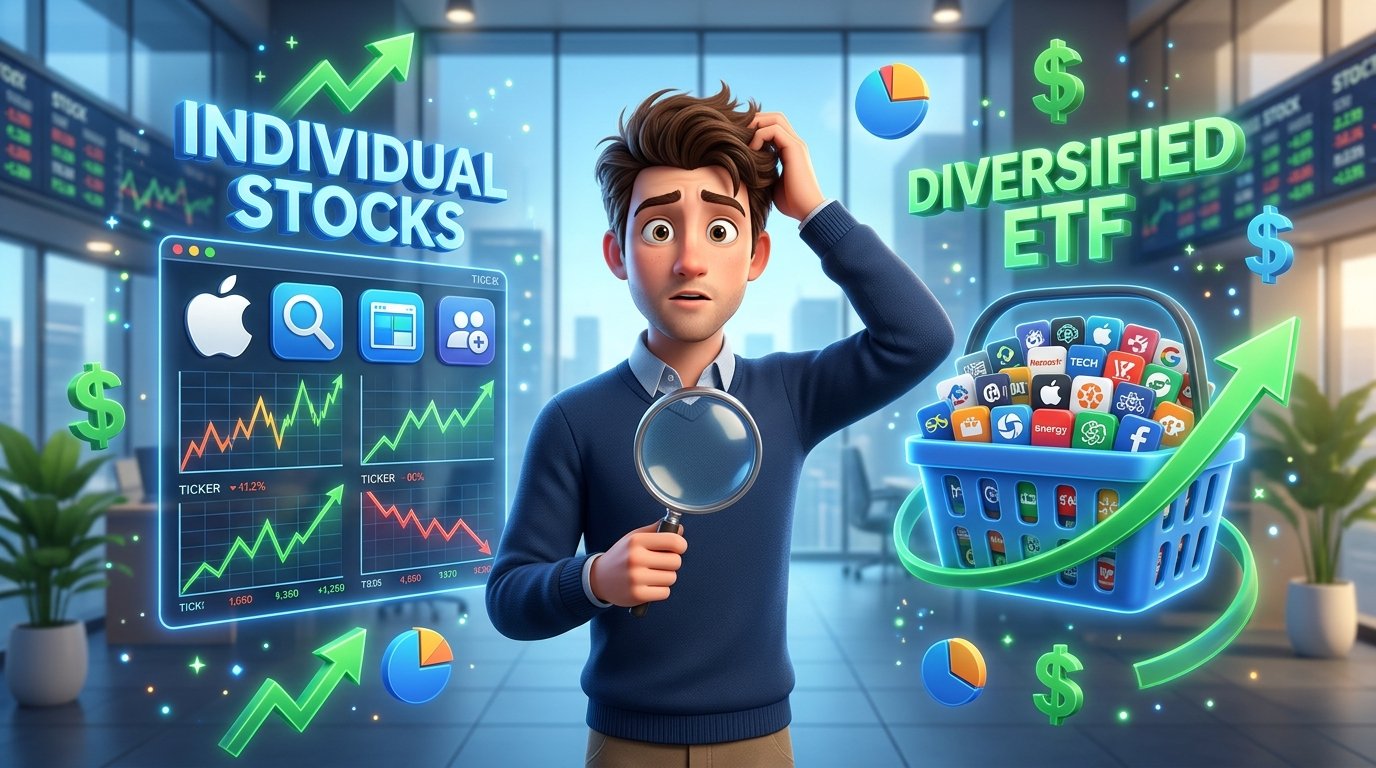
Investing can be one of the most effective ways to build wealth over time. However, when beginners enter the stock market, they often face an important question: Should they invest in individual stocks or exchange-traded funds (ETFs)?
Both options offer opportunities to grow your money, but they work differently. Individual stocks allow you to own a small part of a particular company, while ETFs let you invest in a collection of different investments through a single fund.
For example, you could purchase shares of Apple or Microsoft individually. Alternatively, you could invest in an ETF that holds shares of hundreds of companies.
So, which option makes more sense for someone just starting out?
In this guide, we’ll explain how stocks and ETFs work, compare their advantages and disadvantages, and help you understand which investment approach may suit your financial goals.
Table of Contents
-
What Are Individual Stocks?
-
What Are ETFs?
-
Stocks vs. ETFs: Key Differences
-
Advantages of Investing in Individual Stocks
-
Disadvantages of Individual Stocks
-
Advantages of Investing in ETFs
-
Disadvantages of ETFs
-
Which Is Better for Beginners?
-
How Much Money Do You Need to Start?
-
Common Investing Mistakes to Avoid
-
Final Verdict
1. What Are Individual Stocks?
An individual stock represents a small ownership share in a publicly traded company.
When you purchase a company’s stock, you become a shareholder. This means your investment value can increase or decrease depending on the company’s performance and market conditions.
For example, if you purchase shares of companies such as Apple or Microsoft, you own a small portion of those businesses.
Investors generally make money from individual stocks in two ways:
-
Capital appreciation: Selling shares for more than you originally paid.
-
Dividends: Receiving payments distributed by eligible companies to shareholders.

However, investing in individual stocks requires research. A company’s financial performance, competition, management decisions, and market conditions can all affect its share price.
2. What Are ETFs?
ETF stands for Exchange-Traded Fund. It is an investment fund that holds a collection of assets, such as stocks, bonds, or other investments.
Instead of purchasing shares in several companies separately, you can buy one ETF that provides exposure to multiple companies.
For example, the Vanguard S&P 500 ETF (VOO) tracks the S&P 500 Index, giving investors exposure to approximately 500 leading US companies.
Other popular ETFs include:
-
SPDR S&P 500 ETF (SPY)
-
iShares Core S&P 500 ETF (IVV)
-
Vanguard Total Stock Market ETF (VTI)
One major advantage of ETFs is diversification. Your investment is spread across multiple holdings rather than depending entirely on one company.
However, diversification does not eliminate investment risk. An ETF can still lose value when the overall market declines.
3. Stocks vs. ETFs: Key Differences
Although stocks and ETFs are both traded on stock exchanges, they have several important differences.
Here is a simple comparison:
| Feature | Individual Stocks | ETFs |
|---|---|---|
| Ownership | One company | Collection of investments |
| Diversification | Usually low | Usually higher |
| Risk | Company-specific and market risk | Market and fund-specific risk |
| Research | More company research | Research fund holdings and strategy |
| Management | You choose each stock | Fund follows an investment strategy |
| Fees | Trading fees may apply | Expense ratio may apply |
| Potential returns | Can be very high or low | Depends on underlying holdings |
| Beginner-friendly | Requires more research | Often easier to diversify |
Example: Imagine you have $500 to invest.
You could purchase shares of one company, meaning your investment depends heavily on that company’s performance.
Alternatively, you could invest the $500 in a diversified ETF that holds hundreds of companies.
The ETF spreads your exposure across multiple businesses, although its value can still decline when the market falls.
4. Advantages of Investing in Individual Stocks
Individual stocks can be attractive to investors who enjoy researching companies and identifying potential growth opportunities.
Here are some major advantages.
1. Higher potential returns
A successful company can experience significant growth over time. Investors who purchase its shares early may benefit from substantial price appreciation.
However, higher potential returns also come with greater risk.
2. More investment control
You can select exactly which companies you want to own. If you believe a particular industry or business has strong growth potential, you can invest directly in it.
3. Dividend opportunities
Some established companies distribute dividends to shareholders. These payments can provide an additional source of investment income.
4. Personalized investment strategy
Individual stocks allow you to build a portfolio around your interests, research, and investment goals.
5. Disadvantages of Individual Stocks
Despite their potential benefits, individual stocks have some disadvantages.
-
Higher company-specific risk: Poor business performance can significantly reduce your investment.
-
Research requirements: You need to understand financial statements, company performance, and industry trends.
-
Volatility: Individual stock prices can experience substantial short-term movements.
-
Diversification challenges: Building a diversified portfolio may require purchasing shares in many different companies.
For beginners with limited investment knowledge, choosing individual stocks can be challenging.
6. Advantages of Investing in ETFs
ETFs are popular among beginners because they offer a relatively simple way to access diversified investments.
1. Instant diversification
One ETF can provide exposure to dozens, hundreds, or even thousands of investments.
This helps reduce the impact of poor performance from a single company.
2. Convenient investing
Instead of researching and purchasing many individual stocks, you can buy one fund that follows a particular index or investment strategy.
3. Lower research requirements
You still need to understand an ETF’s holdings, fees, and investment objectives, but you may spend less time researching individual companies.
4. Transparency
Most ETFs publish information about their holdings, allowing investors to understand what they own.
5. Suitable for long-term strategies
Broad-market ETFs can be useful for investors who want diversified exposure and prefer a long-term investment approach.
7. Disadvantages of ETFs
ETFs also have limitations that beginners should understand.
-
Market risk: Diversification cannot protect an ETF from broad market declines.
-
Management fees: Many ETFs charge annual expense ratios.
-
Limited control: You cannot choose individual companies within a standard index ETF.
-
Different investment strategies: Some ETFs focus on narrow sectors or complex strategies, which can carry significant risks.
-
Tracking differences: An ETF may not perfectly match the performance of its underlying index.
Before investing, always review an ETF’s expense ratio, holdings, and investment objectives.
8. Which Is Better for Beginners?
For many beginners, diversified ETFs are a practical starting point.
The main reason is diversification. Instead of depending on one company’s performance, investors can spread their money across many businesses.
Consider these situations:
| Investor Type | Potentially Suitable Option |
|---|---|
| Complete beginner | Broad-market ETFs |
| Long-term investor | Diversified ETFs |
| Company research enthusiast | Individual stocks |
| Investor seeking diversification | Broad-market ETFs |
| Experienced stock picker | Individual stocks |
| Investor wanting a combination | Stocks and ETFs |
Why ETFs May Be Easier for Beginners
Imagine you invest $1,000 in an individual company’s stock. If that company experiences serious financial problems, your investment could lose considerable value.
Now imagine investing the same amount in a diversified ETF containing hundreds of companies.
Even if one company performs poorly, the impact on the entire fund may be smaller.
This does not guarantee profits, but it can reduce the risk associated with depending on one business.
9. How Much Money Do You Need to Start?
You do not necessarily need thousands of dollars to begin investing.
Many US brokerage platforms allow investors to purchase fractional shares, meaning you can invest smaller amounts instead of buying a complete share.
For example, consider this hypothetical monthly investment plan:
| Monthly Investment | Annual Contribution |
|---|---|
| $25 | $300 |
| $50 | $600 |
| $100 | $1,200 |
| $200 | $2,400 |
| $300 | $3,600 |
The important thing is consistency.
Example: Investing $100 Every Month
Suppose you invest $100 every month for 10 years.
-
Monthly investment: $100
-
Investment period: 10 years
-
Total contributions: $12,000
-
Assumed annual return: 7%
With monthly compounding, your investment could grow to approximately $17,300.
Illustrative calculation only. Actual investment returns are not guaranteed, and market performance can be negative.
This example demonstrates how regular contributions and compounding can work together over time.
https://www.homaio.com/en/blog/how-to-invest-in-the-stock-market-2026-beginners-guide
10. Common Investing Mistakes Beginners Should Avoid
Whether you choose individual stocks or ETFs, avoiding common mistakes can help you make better financial decisions.
1. Investing without research
Never purchase an investment simply because someone recommends it online. Understand what you are buying.
2. Expecting quick profits
Investing is generally a long-term activity. Trying to become wealthy overnight can encourage unnecessary risks.
3. Ignoring investment fees
Even small annual fees can reduce long-term returns. Always check the expense ratio before purchasing an ETF.
4. Putting all your money into one investment
Concentrating your entire portfolio in one company or narrow industry can expose you to unnecessary risk.
5. Panic selling
Market declines are part of investing. Making emotional decisions during periods of volatility can negatively affect your long-term strategy.
6. Investing money you need soon
Stock investments can decline unexpectedly. Avoid investing emergency savings or money needed for near-term expenses.
11. Final Verdict: Stocks or ETFs?
Both individual stocks and ETFs can play an important role in an investment portfolio.
However, for many beginners, diversified ETFs offer a simpler starting point because they provide exposure to multiple companies without requiring investors to select each business individually.
Individual stocks may be more appropriate for people who enjoy researching companies, understand investment risks, and want greater control over their portfolios.
You do not necessarily have to choose only one. Some investors build a diversified ETF portfolio as their foundation and allocate a smaller portion of their investments to individual stocks.
Ultimately, the best investment depends on your financial goals, risk tolerance, investment knowledge, and time horizon.
Remember: Successful investing is not about finding the fastest way to make money. It is about making informed decisions, managing risk, and remaining consistent over time.
Frequently Asked Questions (FAQs)
1. Are ETFs safer than individual stocks?
ETFs can reduce company-specific risk through diversification, but they are not risk-free. Their value can decline during market downturns.
2. Can beginners invest in ETFs?
Yes. Beginners can invest in ETFs through eligible brokerage accounts. Broad-market ETFs are commonly used for diversified, long-term investing.
3. Can you lose money investing in ETFs?
Yes. ETFs can lose value if their underlying investments decline. Some specialized ETFs can also carry additional risks.
4. How many stocks should a beginner own?
There is no universal number. Beginners may find diversified funds easier than managing a portfolio of numerous individual stocks.
5. Should I invest in stocks or ETFs for the long term?
Both can be used for long-term investing. Broad-market ETFs may offer a convenient diversified approach, while individual stocks require more research and company-specific risk management.