
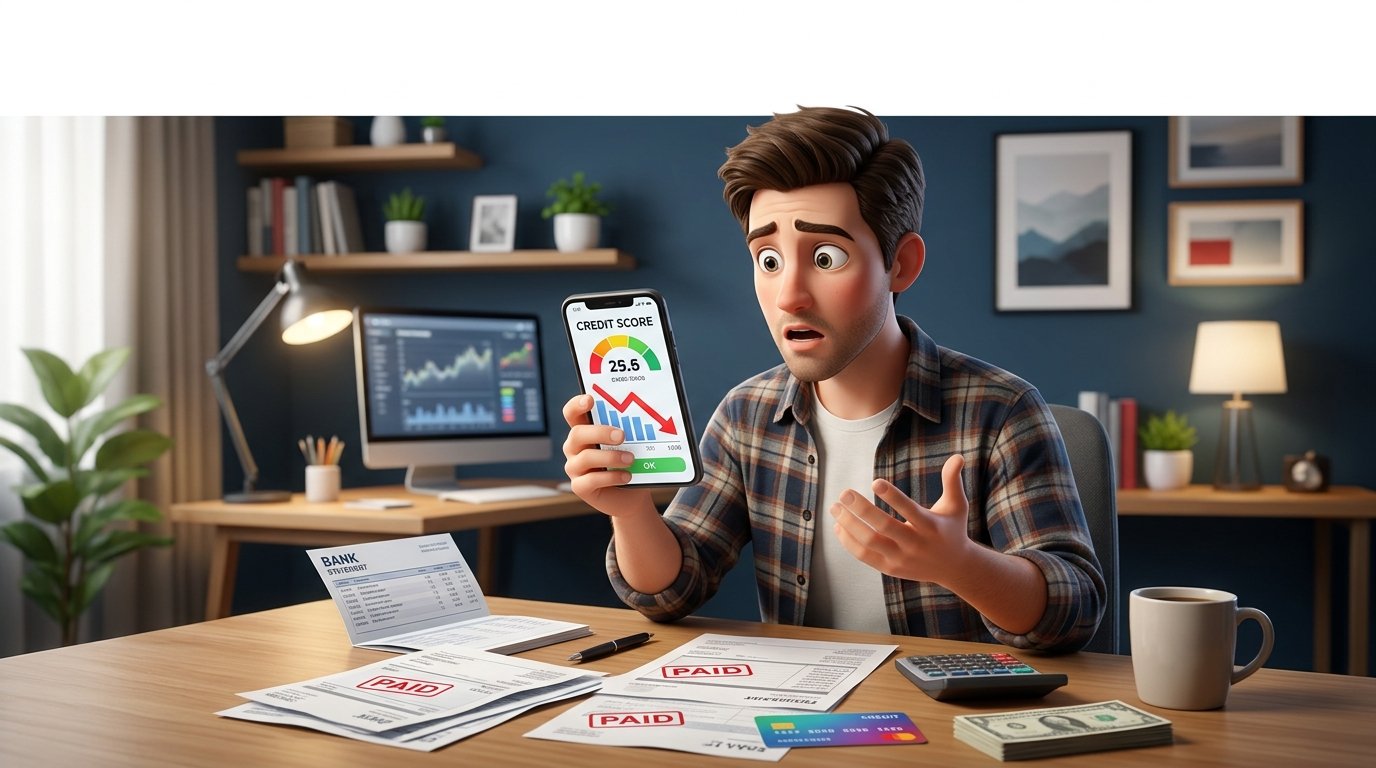
Why Your Credit Score Dropped Even Though You Paid Your Bills
Have you ever checked your credit score, felt confident because you paid your bills on time, and then discovered that your score had dropped? It can be frustrating, especially when you believe you are doing everything right.
The truth is that paying your bills on time is one of the most important parts of maintaining a healthy credit history, but it is not the only factor that affects your credit score. Your credit card balances, account activity, credit applications, and the information reported by lenders can also influence your score.
In the United States, credit scores are calculated using information in your credit reports. Depending on the scoring model, a score can change even when you have never missed a payment.
The good news is that a credit score decrease does not automatically mean you have made a serious financial mistake. Sometimes, the change is temporary. Other times, it points to an issue that deserves your attention.
In this guide, you will learn why your credit score might have dropped despite paying your bills, how to identify the cause, and what you can do to help your score recover.
Table of Contents
- Why Your Credit Score Can Drop After Paying Bills
- Your Credit Card Balances Increased
- Your Credit Utilization Ratio Went Up
- You Applied for New Credit
- You Closed an Old Credit Card
- Your Credit Report Contains an Error
- A Payment Was Reported Late
- Your Credit History Is Still Relatively Short
- You Paid Off a Loan
- Your Credit Mix Changed
- Your Credit Score Provider Uses a Different Model
- How to Find Out Why Your Score Dropped
- How to Help Your Credit Score Recover
- Frequently Asked Questions
1. Why Your Credit Score Can Drop After Paying Bills
Your credit score reflects several aspects of your credit history, not just whether you make payments on time.
For example, imagine that you paid your credit card bill before its due date. However, your card balance was relatively high when your lender reported your account information to the credit bureaus. Your score might decrease because the reported balance increased your credit utilization ratio.
Similarly, applying for a new credit card, closing an account, or having an inaccurate item appear on your credit report may affect your score.
In the United States, the three major nationwide credit reporting companies are Equifax, Experian, and TransUnion. Information on your reports may differ because lenders do not necessarily report every account to every bureau at the same time.
Your credit score may therefore vary depending on the credit bureau, scoring model, and date on which the score was calculated.
The key point: Paying bills on time is essential, but it does not guarantee that your credit score will increase every month.

2. Your Credit Card Balances Increased
One common reason for a credit score decrease is an increase in credit card balances.
You may pay every bill on time while continuing to use your credit cards for groceries, fuel, online purchases, and other everyday expenses. If your spending increases, the balances reported to the credit bureaus may also increase.
Consider this example:
Imagine you have a credit card with a $5,000 limit. Last month, your reported balance was $500. This month, it increased to $2,000.
Your payment history may remain perfect, but the higher balance could negatively affect your credit score.
This does not necessarily mean you are in financial trouble. It means the amount of credit you are using has changed, and the scoring model may respond to that change.

How to manage your balances
- Pay down credit card balances when possible.
- Avoid charging more than you can comfortably repay.
- Check your statement balances regularly.
- Consider making an additional payment before the statement closing date if you want to reduce the balance reported.
- Keep enough cash available for essential expenses rather than using all your savings to pay off a card.
You do not need to carry a credit card balance and pay interest to build a positive credit history. Paying your statement balance in full by the due date is generally a good way to avoid interest on purchases when your card has a grace period and you qualify for it.
3. Your Credit Utilization Ratio Went Up
Credit utilization measures how much of your available revolving credit you are using. It is an important factor in many widely used credit scoring models.
The calculation is straightforward:
Credit utilization = Reported credit card balances ÷ Total credit limits × 100
For example, suppose your total credit card limits equal $10,000.
| Total reported balances | Credit utilization |
|---|---|
| $500 | 5% |
| $2,000 | 20% |
| $3,000 | 30% |
| $5,000 | 50% |
As your reported balances rise relative to your limits, your credit utilization increases. That change can contribute to a lower score.
People sometimes assume that making a payment before the due date guarantees a low reported balance. However, many card issuers report balances around the statement closing date, although reporting practices vary.
For this reason, your credit report may show a balance even if you pay the card in full every month.
What is a good credit utilization ratio?
Lower utilization is generally better for many scoring models. Keeping it below 30% is a commonly used guideline, but it is not a guaranteed threshold for a particular score. A lower percentage may be beneficial, and there is no need to carry debt or pay interest to achieve it.
If you want to lower utilization, you can reduce your balances, avoid unnecessary purchases, or consider requesting a higher credit limit if you can manage the account responsibly.
Do not spend more or apply for additional credit solely to manipulate your score.
4. You Applied for New Credit
Applying for a new credit card, personal loan, or other credit product may result in a hard inquiry on your credit report.
A hard inquiry occurs when a lender checks your credit as part of a credit application. Depending on your credit profile and scoring model, it can cause a small, temporary decrease in your score.
For example, you might have a credit score of 740 and apply for a new rewards credit card. The lender reviews your credit report, and your score subsequently changes.
The inquiry could be one reason for the change, although you should check for other factors before assuming it is the only cause.
How to avoid unnecessary inquiries
- Research credit products before applying.
- Use prequalification tools when available, checking whether they use a soft inquiry.
- Avoid submitting several unrelated credit applications in a short period.
- Apply for new credit when you have a genuine need.
- Check the terms and eligibility requirements before submitting an application.
Certain mortgage, auto loan, and student loan inquiries may receive special treatment under particular scoring models when they occur within a specified rate-shopping window. The rules vary by model, so do not assume every type of credit inquiry is treated identically.
Checking your own credit report or score is generally considered a soft inquiry and does not lower your credit score.
5. You Closed an Old Credit Card
Closing a credit card can sometimes contribute to a lower credit score, particularly if it reduces your total available revolving credit.
For example, imagine you have two credit cards:
- Card A has a $7,000 credit limit.
- Card B has a $3,000 credit limit.
Together, they provide $10,000 in available credit. If you close Card A, your remaining limit falls to $3,000.
If you continue to have balances on Card B, your overall utilization ratio may increase substantially.
Closing a card does not automatically damage every person’s credit score, and the effect depends on the credit profile and scoring model. The treatment of closed accounts and their age also varies by scoring system and report.
Should you keep an old credit card open?
Consider the following before closing an account:
- Does it have an annual fee?
- Does it encourage unnecessary spending?
- Would closing it significantly reduce your available credit?
- Can you keep it open safely without incurring costs?
- Does the issuer offer a no-annual-fee alternative?
If an account has a high annual fee, ask the issuer whether a product change is available. Never keep a costly or difficult-to-manage account open solely for the sake of your score.
6. Your Credit Report Contains an Error
Sometimes, a score decrease has nothing to do with your financial behavior. Incorrect information on your credit report may be responsible.
Possible errors include:
- A payment incorrectly marked late.
- An account that belongs to someone else.
- A balance that has not been updated.
- A debt that was paid but is still shown incorrectly.
- Duplicate accounts or inaccurate personal information.
- Signs of identity theft or fraudulent credit applications.
For example, you may have paid a credit card bill on time, but the lender’s records incorrectly show that the payment was late. If that information appears on a credit report, it could harm your score.
How to check your credit reports
In the United States, you can request your credit reports through the federally authorized website, AnnualCreditReport.com.
Review reports from Equifax, Experian, and TransUnion because their information may not be identical.
If you find inaccurate information, dispute it with the relevant credit reporting company and, when appropriate, the company that supplied the information. Include supporting documents, such as payment confirmations or statements, and keep copies of your communications.
You can learn more about your rights and the dispute process through the Consumer Financial Protection Bureau (CFPB) and the Federal Trade Commission (FTC).
Do not pay a company simply to access your free credit reports from the authorized source.
7. A Payment Was Reported Late
Even if you believe you paid your bills on time, a payment may have been processed late or reported incorrectly.
Possible reasons include:
- You scheduled the payment close to the deadline.
- Your bank transfer was delayed.
- An automatic payment failed because of insufficient funds.
- Your payment went to the wrong account.
- A lender made a reporting mistake.
In the United States, credit card issuers generally cannot report a payment as delinquent to the nationwide credit bureaus until it is at least 30 days past due. However, a late payment can trigger fees or other consequences before it reaches that reporting threshold.
A reported late payment can have a meaningful effect on your credit score, depending on your credit history and the scoring model.
What should you do?
First, check your payment confirmation and the lender’s statement. If you believe the payment was reported incorrectly, contact the lender and dispute the inaccurate information with the credit reporting company.
If you genuinely missed a payment, bring the account current as soon as you reasonably can and contact the creditor if you need help. The impact of accurate negative information generally cannot be erased simply by asking for it to be removed.
8. Your Credit History Is Still Relatively Short
A short credit history can make it harder for scoring models to assess your long-term borrowing behavior.
You might pay all your bills on time but still have a limited history because you recently opened your first credit card or have few credit accounts.
For example, a person who has used credit responsibly for six months has less historical information than someone with several years of positive payment records.
As a result, a new account or a change in reported balances may have a different effect on someone with a limited credit history.
How to build a longer positive history
- Pay your accounts on time.
- Avoid opening unnecessary accounts.
- Keep older accounts that are useful and manageable.
- Use credit sparingly and responsibly.
- Give your credit history time to develop.
There is no instant way to create a long credit history. Consistent habits are more valuable than frequently applying for new products.
9. You Paid Off a Loan
Paying off a loan is generally a positive financial achievement. However, your credit score may sometimes decrease after a loan is paid off and the account is closed.
One possible reason is that the change affects the types of accounts you have open or the overall information available to a particular scoring model.
For example, paying off an auto loan may leave you with only credit cards. Depending on your remaining credit history and the model being used, that change may affect your score.
This does not mean you should keep paying interest just to preserve a credit score.
What should you do after paying off a loan?
- Confirm that the loan is reported as paid off.
- Check that the final balance is accurate.
- Continue paying other accounts on time.
- Avoid taking out a new loan solely to improve your credit mix.
- Monitor your credit report for inaccurate information.
Being debt-free can improve your financial flexibility, even if your credit score experiences a temporary change.
10. Your Credit Mix Changed
Credit mix refers to the different types of credit accounts in your credit history. These may include revolving accounts, such as credit cards, and installment loans, such as auto loans.
Some credit scoring models consider credit mix as one of several factors. However, it is generally not a good idea to open a loan you do not need just to add another type of credit.
For example, if you have only one credit card and no installment loan history, your credit profile may look different from someone who has responsibly managed several types of credit.
That difference does not mean you need to borrow money unnecessarily.
How to approach credit mix
Focus on maintaining the accounts that make sense for your financial situation. Pay your existing obligations on time, keep balances manageable, and avoid unnecessary debt.
A strong credit profile is about responsible credit management, not collecting as many financial products as possible.
11. Your Credit Score Provider Uses a Different Model
You may see different credit scores depending on where you check them. This does not necessarily mean one of them is wrong.
Lenders and consumer services may use different scoring models, including different versions of FICO and VantageScore. They may also use information from different credit bureaus.
For example, your bank might show a score of 735 while a credit monitoring service displays 721. The scores may have been calculated using different models or report information from different dates.
Even when the same model is used, a score can differ if the underlying credit report data is different.
How to compare credit scores correctly
- Check which credit bureau supplied the information.
- Identify the scoring model and version when available.
- Look at the date the score was calculated.
- Compare the underlying credit reports rather than focusing only on the numbers.
- Avoid assuming that a difference between two services means your credit is damaged.
When applying for a loan, remember that the lender may use a different score from the one you see in a consumer app.
12. How to Find Out Why Your Score Dropped
Rather than guessing, investigate the change systematically.
Step 1: Identify the score that changed
Check which service provided your score, the date it was updated, and the scoring model if that information is available.
Step 2: Review your credit reports
Use AnnualCreditReport.com to obtain your reports from the three major credit reporting companies. Look for new accounts, unfamiliar inquiries, incorrect balances, and payment history changes.
Step 3: Compare reported credit card balances
Calculate your utilization ratio using the balances and limits shown on your reports. A higher reported balance may explain part of the decrease.
Step 4: Check recent account changes
Look for new credit applications, recently closed accounts, paid-off loans, or changes to your available credit.
Step 5: Contact the relevant lender or bureau
If something appears incorrect, contact the company responsible for the information and submit a dispute when appropriate.
Step 6: Monitor the next update
Credit reports are updated as lenders send new information. After addressing the issue, check your reports again to confirm that the correction or balance update has appeared.
13. How to Help Your Credit Score Recover
Once you understand the likely cause, focus on the steps that fit your situation.
.http://Pay every bill on time Payment history is an important part of many credit scoring models. Set reminders or automatic payments to help avoid missed deadlines.
Reduce high credit card balances. Lower reported utilization may help your score, particularly if balances were the main cause of the decrease.
Avoid unnecessary credit applications. Apply for new accounts only when they support a genuine financial need.
Keep track of account limits and balances. Review statements regularly and check your credit reports for updates.
Dispute inaccurate information. If an error appears on your report, provide supporting evidence to the relevant credit reporting company and information provider.
Give changes time to appear. Lenders do not all report information on the same schedule, and score recovery is not guaranteed to happen within a particular number of days.
Do not pay for credit repair promises. Be cautious of companies that guarantee a specific score increase or promise to remove accurate negative information.
Most importantly, do not take on unnecessary debt just to increase your credit score. Your financial well-being matters more than achieving a particular number.
Frequently Asked Questions
Why did my credit score drop 20 points when I paid everything on time?
A 20-point decrease can result from changes in reported credit card balances, a hard inquiry, an account change, a reporting error, or a different scoring model. Review your credit report and compare the information with your previous report if available.
Can paying off a credit card lower my credit score?
It can sometimes cause a temporary score decrease, depending on how reported balances and account information change. However, paying off credit card debt is generally beneficial for your finances and can reduce interest costs.
Does checking my own credit score lower it?
Generally, no. Checking your own score or requesting your own credit report is typically treated as a soft inquiry, which does not lower your credit score.
How long does it take for a credit score to recover?
There is no universal recovery timeline. If the decrease resulted from high reported balances, the score may change after lower balances are reported. Other situations, such as accurate late payments, may take considerably longer to improve.
Can a credit score drop without any missed payments?
Yes. Your score can change because of credit utilization, new inquiries, account closures, changes to your credit profile, or differences in the scoring model.
Should I carry a credit card balance to build my score?
No. You generally do not need to carry a balance or pay interest to build a positive credit history. Use your card responsibly and pay your statement balance in full when possible.
Final Thoughts
Seeing your credit score drop when you have paid your bills on time can be confusing, but it does not automatically mean you have done something wrong.
Your credit score reflects more than your payment history. Credit utilization, new applications, account changes, reporting errors, and the scoring model itself can all influence the number you see.
Start by reviewing your credit reports, checking your reported balances, and identifying any recent changes. If you find an error, dispute it. If your utilization has increased, consider reducing your balances and monitoring future updates.
You cannot control every monthly movement in your score, but you can build habits that support a stronger credit profile over time.
Remember: the goal is not simply to maintain a high credit score. It is to manage credit responsibly while building a healthier financial future.
Disclaimer: This article is for educational purposes only and does not constitute personalized financial, legal, or credit advice. Credit score changes and scoring factors vary by model and individual credit profile.
1 thought on “13 Steps Why Your Credit Score Dropped Even Though You Paid Your Bills”